
Where the page ends and the screen begins: the dialogue between books and TV series
At the end of September, at the Premio Solinas in La Maddalena, the relationship between publishing and audiovisual media took center stage in a dedicated panel. It was titled “Where the page ends, where the screen begins”. It wasn’t about a new release, but about a different way of discovering stories.
The Premio Solinas is Italy’s leading award for audiovisual writing. It brought together over 150 professionals in La Maddalena, including screenwriters, directors, producers and broadcasters. The fact that books were discussed at a cinema event says a lot.
Where the conversation started
The discussion grew out of the research “From Screen to Page”, carried out by NIQ for Netflix. It had already been presented in May at the Turin Book Fair. At La Maddalena it was discussed with authors and screenwriters, introduced by Luisa Cotta Ramosino, head of Netflix Italy’s series.
The study looked at 187 films and series released between 2022 and 2025, along with the books they were based on. In the four weeks after an adaptation came out, sales of the books grew by almost 200% on average compared with the previous period.
A two-way street
The panel asked whether films and series are making us read more. But the discussion went further than that. It was about a new way of discovering, experiencing and sharing stories.
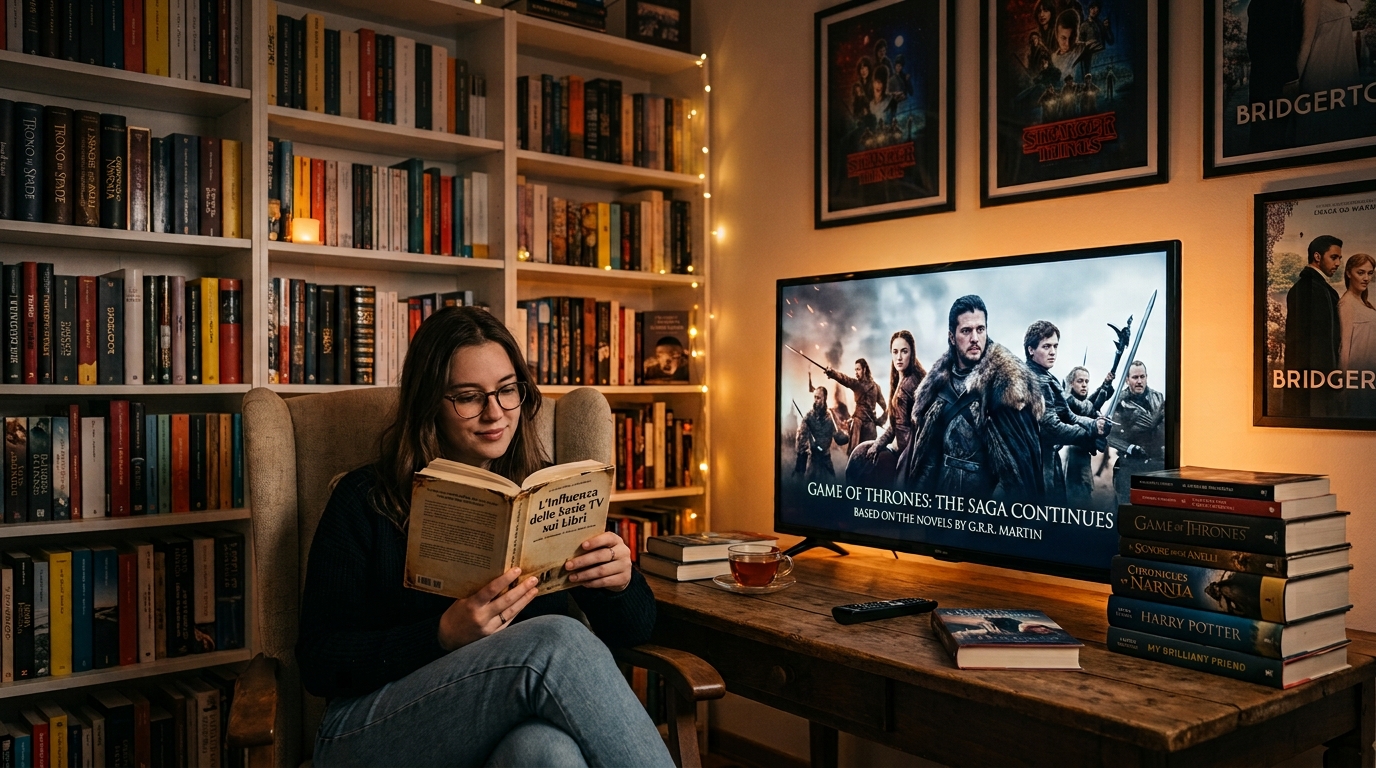
The path is no longer linear. It used to be the book first, then the adaptation. Today it can work the other way around. You watch a series, feel the need to dig deeper, and look for the novel. Then you go back to the screen with different eyes. Readers and viewers are increasingly the same people.
Why it matters to readers
Among the panelists was screenwriter Doriana Leondeff, who worked with Silvio Soldini on a film based on a novel. It’s a good example of how writing for the screen and writing for the page really do speak to each other, even at the level of craft.
For readers, the benefit is concrete: an adaptation becomes another way into reading. A book left on the shelf can get noticed again thanks to a series. Stories born in different formats (text, audio, comics, images) end up in conversation with each other.
It’s worth remembering that the research was commissioned by a streaming platform, so its viewpoint is inevitably partial. But the phenomenon is something anyone can observe. How many times, after an episode, have we gone looking for the book it was based on?
Related articles


